We all know BMI is pretty useless for predicting CV risk, and a new JACC analysis puts hard numbers on just how much it misses, including a high-risk group hiding in plain sight among “normal weight” patients.
- Body Mass Index (BMI) uses your height and weight to estimate your body fat, though it doesn’t distinguish between fat, muscle, and bone.
- Meanwhile, metrics like waist circumference (WC) and waist-to-hip ratio (WHR) have been used to quantify what’s called “central adiposity” or visceral fat.
If you’re up to date, you already know that visceral fat contributes directly to cardiovascular risk. This association prompted researchers to follow 260k patients with various WC and WHR measurements for a median of 20 years.
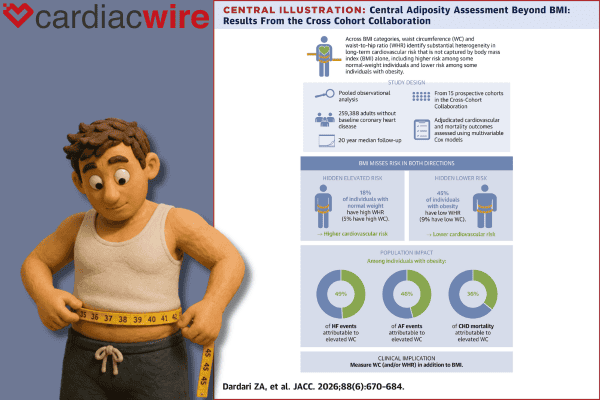
- Among people classified as normal by BMI, 5% had high WC and 18% had high WHR.
- Conversely, in those classified as obese by BMI, 9% had low WC and 45% had low WHR.
To right these BMI wrongs, researchers reclassified patients by WC and WHR to see those metrics’ prognostic value for nine CV outcomes ranging from HF to AFib, and all-cause mortality.
- For BMI normal-weight or overweight individuals, high WC or WHR was associated with 15% to 50% greater risk across most outcomes.
- Among people with BMI-defined obesity, low WC translated to lower all-cause mortality risk but no significant difference for other outcomes.
Does this mean we can make the case for measuring waists? Among people with obesity, elevated waist measurements coincided with a large share of events.
- Elevated WC was attributable to 49% of HF events, 46% of AFib events, and 36% of coronary heart disease mortality.
- That’s a substantial fraction of cardiovascular burden that BMI-based assessment alone would fail to flag.
There’s a timely treatment angle, too. The findings land as GLP-1s redefine how we manage weight loss, and more specifically, a patient’s organ fat.
- Novo Nordisk’s SELECT trial and studies on Eli Lilly’s Mounjaro found that GLP-1s lead to reduced CV risk likely tied to organ fat loss rather than total weight reduction.
The Takeaway
In Brazil, there’s this concept of a falsa magrinha (false skinny), where someone looks healthy, but it’s only because they mostly have weight from fat and not muscle. This JACC analysis gives us a way to catch the people who would slip through the BMI cracks and into CVD.