While coronary artery bypass grafting (CABG) is widely-considered a safe procedure, some patients are more prone to potentially fatal complications. A new study shows two common biomarkers could work together to catch those high-risk patients.
- CABG is successful about 97% of the time, but some patients develop complications that can cause death within 30 days of the procedure.
- Currently, two major biomarkers stand out for detecting cardiac injury, high-sensitivity cardiac troponin T (hs-cTnT) and creatine kinase–myocardial band (CK-MB).
- While hs-cTnT has overshadowed CK-MB in guidelines, some research suggests that CK-MB has its benefits when it comes to detecting procedural myocardial injury.
In an effort to develop a new biomarker screen for post-CABG risk, researchers measured CK-MB and hs-cTnT levels in 9.9k patients within 72 hours of CABG. The peak values of these biomarkers were then evaluated on how well they predicted 30-day mortality and the surface-level stats were interesting…
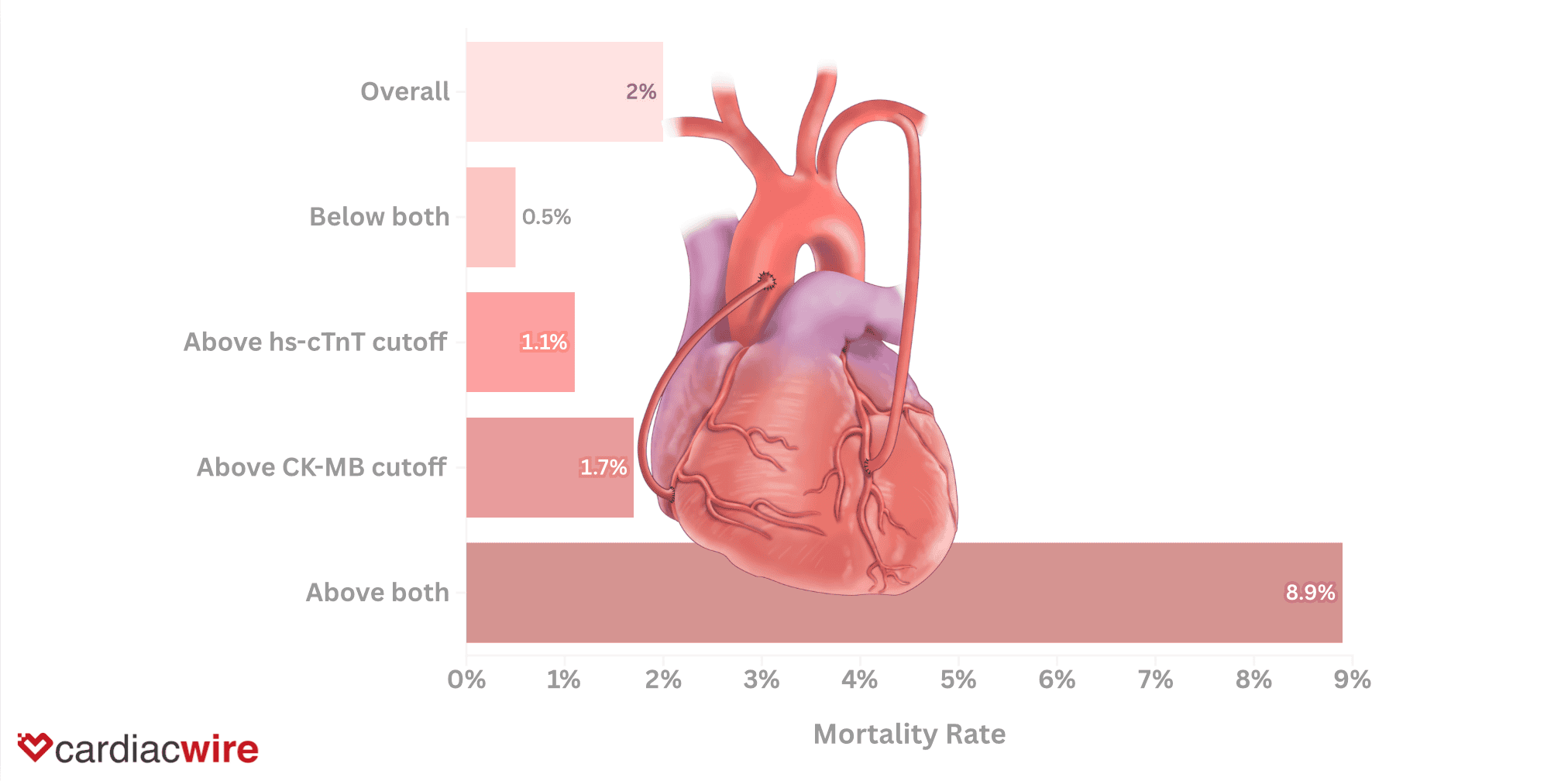
- The patient population’s all-cause mortality rate was 2%.
- When applying CK-MB and hs-cTnT separately, the biomarkers had similar (and solid) predictive accuracies (AUC 0.787 vs. 0.784) — though not quite at the clinical standard.
But together, the biomarkers delivered a bigger breakthrough. After researchers placed patients into three groups based on concentrations of each molecule, the pooled data showed…
- When both biomarkers were elevated beyond the diagnostic threshold, patients had mortality rates 18x higher than those with non-elevated concentrations (8.9% vs 0.5%).
- But elevated levels of CK-MB and hs-cTnT individually weren’t significantly associated with mortality.
Like the saying goes, two heads are better than one, and that’s true for cardiac biomarkers too. CK-MB and hs-CTnT measure cardiac injury differently, which might be part of this dual-marker approach’s success, while cluing us in to what future research needs to cover…
- For example, this study captured peak values of each biomarker, not continuous levels or when the peaks occurred.
- Since the molecules clear from the body on very different timelines (just 48-72 hours for CK-MB), time-specific data is needed to better define the risk categories.
The Takeaway
Accounting for high levels of both hs-CTnT and CK-MB instead of one or the other could help clinicians pinpoint who’s most at-risk of cardiac injury or death after CABG. This early detection could give cardiologists another chance to address patients’ complications before they become fatal.