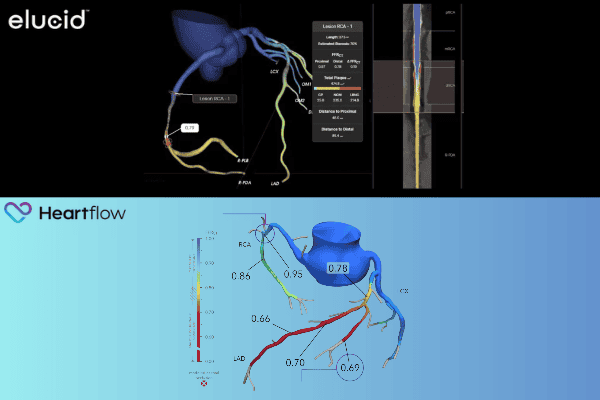
Heartflow, the AI plaque analysis and FFR-CT incumbent, has once again taken the legal route to defend its cardiac CT software market share by suing Elucid for patent infringement and trade secret theft.
- Heartflow is one of two dominant CCTA advanced analysis vendors in the U.S., the other being Cleerly.
- Elucid is emerging as a promising third competitor, with its own plaque analysis software called Plaque-IQ (FDA-cleared 2024) and its newly cleared FFR-IQ software.
- However, Heartflow holds 600+ patents and an FDA de novo clearance that allows it to claim its FFR techology had no “predicate device.”
This new Elucid lawsuit is the second this year, with Heartflow first going after Cleerly in April over claims of patent infringement and using insider information to develop a competing plaque analysis software.
- The suit calls out six plaque analysis patents while alleging that Cleerly’s founder, James K. Min, MD was a Heartflow consultant when he started Cleerly.
- More specifically, Heartflow claims that Dr. Min was privy to patent No. 9,770,303 during his time as a consultant.
- That patent details the machine learning logic Heartflow uses to assess the unstable arterial blockages most likely to rupture and cause acute heart attacks.
Cleerly and Dr. Min responded by reaffirming the extensive and well-established intellectual property portfolio behind how it developed its own plaque analysis software.
Remember patent No. 9,770,303 from earlier? It’s also used alongside three other patents in Heartflow’s lawsuit against Elucid, with the company taking things even further by claiming trade-secret theft.
- That’s because the patent also outlines how Heartflow’s software analyzes plaque composition (like lipid cores or calcification) directly from CCTA scans.
- On the trade secret side, the company claims Elucid hired 11 former Heartflow employees.
- Allegedly, those employees then forwarded customer accounts and commercialization plans to their personal emails.
At the core of the Elucid suit is an FDA 510(k) filing detail. When Elucid submitted its FDA 510(k) documents for FFR-IQ, it named Heartflow’s FFRct as its sole predicate device and used the term “same as predicate” when explaining its indications.
- This isn’t an admission of guilt though, it’s a requirement of the 510(k) process to say “our device works like this other one” for establishing safety and clinical applicability.
Much like Cleerly earlier this year, Elucid’s response underscored the uniqueness of its products and technology, with confidence in their independent development and robust intellectual property portfolio.
So what does all this legalese mean for Elucid and Cleerly? It’s up to the courts to decide if Heartflow’s infringement claims are strong enough, though it’s worth noting that software patents are notoriously hard to defend in court.
- Discovery will reveal whether the espionage claims have merit and it’s unclear whether Heartflow will seek preliminary injunctions to halt Elucid’s and Cleerly’s sales.
The Takeaway
Cardiology medtech has never seen this level of legal protectionism in its software segment before now. Should Heartflow win these cases, it would set a historic precedent for software patents and predicate devices in the industry, while giving the company a monopoly on CCTA analysis software. If Heartflow doesn’t, the FFR-CT segment will have a solid group of competitors driving the market forward.