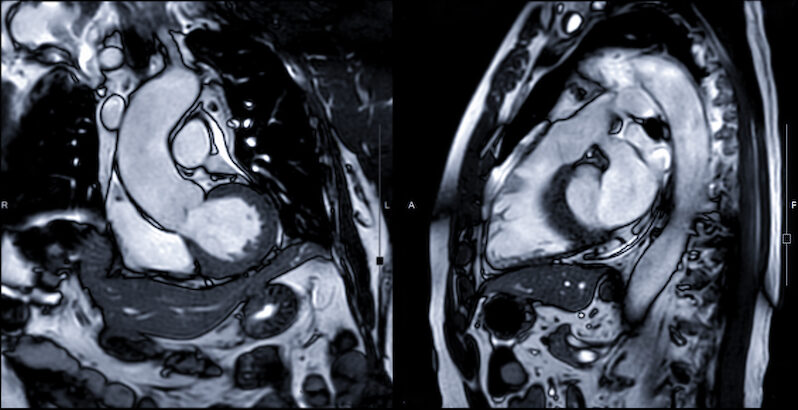
The gold standard for spotting myocardial scarring requires injecting gadolinium contrast during cardiac MRI, which adds time, cost, and a barrier for patients who can’t receive it. Now a new study suggests AI may replace that injection in some cases.
- The technology, called virtual native enhancement (VNE), uses a generative AI model to combine precontrast images into simulated late gadolinium enhancement (LGE) images.
- VNE has been around since 2021, and was developed by an international team of researchers including leaders from the University of Oxford and UVA.
- This JACC study marks VNE’s first major prospective, multicenter, blinded, real-world validation clinical trial.
Researchers collected CMR data from two independent sites in the U.K. and China with each site’s team determining scar ground truth from LGE while a blinded Oxford team generated and scored VNE images using only precontrast data.
- The study focused on 136 patient cases across two common scenarios: ischemic heart disease and viability assessment.
- The AI model received no additional tuning, making the results more generalizable.
When used on clear, high quality CMR images, VNE’s accuracy approached the gold standard.
- VNE detected myocardial infarction with 94.4% accuracy.
- Scar quantification was also very similar to LGE (R = 0.90) with 3.2% average difference.
- Agreement on which parts of the heart muscle were infarcted reached 90.0%.
Here’s the real headline: When four independent clinical readers assessed the images, they said no contrast imaging follow-up was needed in 69.7% of patients.
- In those cases, VNE achieved 93.7% diagnostic accuracy, compared to LGE’s 93.9%.
Now before you go pouring out your gadolinium bottles, there’s caveats. The impressive numbers above only hold true for high-quality scans.
- Across all image qualities, pooled VNE accuracy dropped to 81.1% versus 92.3% for LGE.
- The technique also showed a bias in quantifying small lesions and missed a small infarct.
The Takeaway
Is VNE going to completely replace gadolinium contrast? Probably not. However, this study provides a valuable assessment of what VNE can do, which is that it can effectively replace LGE for patients who can’t receive contrast so long as CMR scan quality is high.