Here’s an encouraging factoid –the number of cardiologists in the U.S. rose in the last 20 years. However, a recent JACC study suggests per-capita cardiologist density has actually declined since 2003, and the average cardiologist’s age keeps creeping higher.
- The U.S. has long struggled to supply enough physicians for its aging population, mostly due to a combination of capped residency funding and baby-boomer demographics.
- That issue is even harder to address in a specialized branch of medicine like cardiology, despite CVD being the leading cause of death in America.
To better understand the shifting cardiology workforce, researchers analyzed AMA Physician Masterfile data reported from 2005-2023 with a keen eye for workforce size and composition relative to the U.S. population.
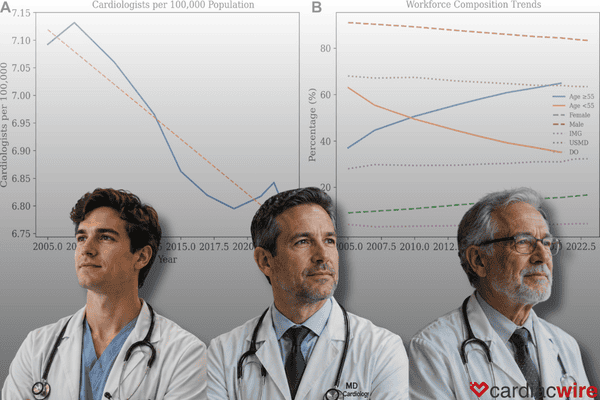
- Absolute cardiologist numbers rose modestly, from 21,117 in 2005 to 22,843 in 2023.
- But population growth outpaced that expansion, leading to a 0.29% annual decline in cardiologists per 100k people.
The more concerning trend is that the average cardiologist is getting older, meaning much of the workforce is set to retire in the next 10-15 years.
- The share of cardiologists aged 55+ jumped from 37.0% in 2005 to 64.9% by 2021.
- That aging trend will only get worse, since the young-to-old replacement ratio also fell significantly (-0.065 per year).
Cardiologist demographic composition also showed slight diversification, though the pace tells its own story.
- Female representation rose from 9.0% to 16.7%.
- But at the current rate, women wouldn’t reach 25% of the workforce until around 2040.
- International medical graduates also grew from 28.0% to 32.3% of the workforce.
It’s not like cardiologists grow on trees, so what do we do about the per-capita dip in the workforce?
- The study suggests reallocating cardiologists might be more pragmatic than simply training more.
- For example, late-career cardiologists could be used for consultative or call-free outpatient roles.
- And of course, advanced practice providers could help fill some care gaps, though probably not to the level seen in primary care.
The Takeaway
Despite raw numerical growth in the cardiologist workforce, we’re still barreling toward a shortage of professionals. This JACC study clarifies that it’s not for a lack of trying, rather a rapidly ageing patient and physician population.