|
CCTA Software Lawsuits, PE in ASCVD, and Early CAC Scores
By Viktor Zarev
October 26, 2026
|
|
|

|
|
Together with
|

|
|
|
“When a Medicare patient doesn’t pay their deductible or coinsurance at a hospital, Medicare pays the hospital back 65% of it. When the same patient doesn’t pay my office, Medicare pays me nothing. Why is the hospital’s bad debt Medicare’s problem and mine isn’t?”
|
|
Andrew Yang, MD
|
|
|
One of my favorite things about cardiology is that it’s a team effort. Most patients see their family medicine doc or an internist before ever seeing an electrophysiologist, which is why giving those providers cardiac monitoring tools is so important. That’s what I learned and more in my latest interview with Jennifer Peña, MD and Kyle Lotring about AccurKardia’s AccurECG 2.0 technology. You can watch it here.
Unfortunately, it’s not all teamwork in cardiology AI development, and the lawsuits covered in today’s top story are a great reminder of that.
Thanks for reading,
Vik
|
|
|
|
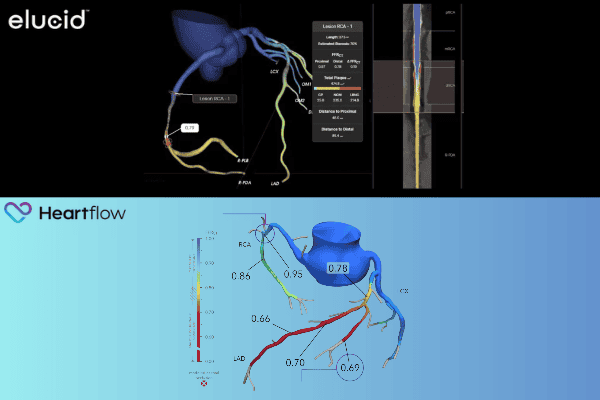
Heartflow, the AI plaque analysis and FFR-CT incumbent, has once again taken the legal route to defend its cardiac CT software market share by suing Elucid for patent infringement and trade secret theft.
- Heartflow is one of two dominant CCTA advanced analysis vendors in the U.S., the other being Cleerly.
- Elucid is emerging as a promising third competitor, with its own plaque analysis software called Plaque-IQ (FDA-cleared 2024) and its newly cleared FFR-IQ software.
- However, Heartflow holds 600+ patents and an FDA de novo clearance that allows it to claim its plaque analysis had no “predicate device.”
This new Elucid lawsuit is the second this year, with Heartflow first going after Cleerly in April over claims of patent infringement and using insider information to develop a competing plaque analysis software.
- The suit calls out six plaque analysis patents while alleging that Cleerly’s founder, James K. Min, MD was a Heartflow consultant when he started Cleerly.
- More specifically, Heartflow claims that Dr. Min was privy to patent No. 9,770,303 during his time as a consultant.
- That patent details the machine learning logic Heartflow uses to assess the unstable arterial blockages most likely to rupture and cause acute heart attacks.
Cleerly and Dr. Min responded by reaffirming the extensive and well-established intellectual property portfolio behind how it developed its own plaque analysis software.
Remember patent No. 9,770,303 from earlier? It’s also used alongside three other patents in Heartflow’s lawsuit against Elucid, with the company taking things even further by claiming trade-secret theft.
- That’s because the patent also outlines how Heartflow’s software analyzes plaque composition (like lipid cores or calcification) directly from CCTA scans.
- On the trade secret side, the company claims Elucid hired 11 former Heartflow employees.
- Allegedly, those employees then forwarded customer accounts and commercialization plans to their personal emails.
At the core of the Elucid suit is an FDA 510(k) filing detail. When Elucid submitted its FDA 510(k) documents for FFR-IQ, it named Heartflow’s FFRct as its sole predicate device and used the term “same as predicate” when explaining its indications.
- This isn’t an admission of guilt though, it’s a requirement of the 510(k) process to say “our device works like this other one” for establishing safety and clinical applicability.
Much like Cleerly earlier this year, Elucid’s response underscored the uniqueness of its products and technology, with confidence in their independent development and robust intellectual property portfolio.
So what does all this legalese mean for Elucid and Cleerly? It’s up to the courts to decide if Heartflow’s infringement claims are strong enough, though it’s worth noting that software patents are notoriously hard to defend in court.
- Discovery will reveal whether the espionage claims have merit and it’s unclear whether Heartflow will seek preliminary injunctions to halt Elucid’s and Cleerly’s sales.
The Takeaway
Cardiology medtech has never seen this level of legal protectionism in its software segment before now. Should Heartflow win these cases, it would set a historic precedent for software patents and predicate devices in the industry, while giving the company a monopoly on CCTA analysis software. If Heartflow doesn’t, the FFR-CT segment will have a solid group of competitors driving the market forward.
|
|
VASCADE MVP® XL Vascular Closure System
Sometimes EP procedures call for a venous vascular closure system that is simply bigger. Haemonetics’ VASCADE MVP XL closure system comes with 58% more collagen and a 9% larger disc compared to the VASCADE MVP system as well as an expanded indication for utilizing 10-14F inner diameter sheaths.
|
|
How to Operationalize and Scale a New CV Service Line
Advances in AI, imaging, and coronary CT are creating new opportunities for cardiovascular care. Explore this Frost & Sullivan Executive Brief for the key things to consider when establishing a coronary plaque service line—from choosing your delivery model to integrating AI cardiovascular imaging workflows and capturing reimbursement value.
|
|
Expand Your Cardiac Reporting with CCT and CMR Workflows
Cardiology imaging continues to grow in complexity, and reporting workflows must evolve to keep pace. Check out how Optum’s latest Change Healthcare Cardiology CPACS release enables cardiology teams to now report CCT and CMR studies natively within their software ecosystem.
|
|
- PE Deaths Climb in ASCVD Patients: A new CDC WONDER analysis suggests that pulmonary embolism deaths are rising among patients with ASCVD. Researchers analyzed data from 2010 to 2023 and discovered that 152k ASCVD patients died of PE during the period with mortality rates jumping from 3.62 to 4.96 per 100,000. The PE mortality rate increases were starkest in adults under 65, Black and Indigenous populations, rural areas, and the Western U.S.
- Heart Deaths Dominate Firefighter Fatalities: As if being a firefighter wasn’t hard enough, a new study in JACC study finds that the job’s cardiovascular risks are immense. Per the study, 43% of on-duty firefighter fatalities were cardiac related over the 35 year data set with the proportion of cardiac-related fatalities rising 2.2% per year even as total deaths fell. Notably, many deaths stemmed from enlarged heart muscle, which standard exercise stress tests miss and which firefighters’ athletic training can mask.
- Olezarsen’s Regulatory Moves in The EU: Sweden’s pharma giant Sobi announced that the EMA’s CHMP recommends expanding TRYNGOLZA’s (olezarsen) indication to adults with severe hypertriglyceridemia. Should the EU regulators move to approve it, TRYNGOLZA would become the first RNA-targeted therapy authorized in the EU for the condition. The recommendation rests on the Phase 3 CORE and CORE2 trials, which showed a triglyceride reduction of up to 72% over 12 months. TRYNGOLZA already earned FDA approval for severe hypertriglyceridemia and was developed by Ionis Pharmaceuticals and, which holds its U.S. commercial rights.
- At-Home Furosemide for HF: Moving towards its goal of getting HF patients home and out of the hospital, SQ Innovation unveiled positive interim results from the Gator SCALES-WHF study of its subcutaneous furosemide formulation, Lasix ONYU. Based in Florida, the study followed 21 HF patients at imminent risk for hospitalization who began same-day at-home treatment after failing oral diuretics, finding that 86% were successfully decongested without hospitalization, with only three admitted within 30 days of starting treatment. The FDA approved Lasix ONYU in October 2025.
- A Device Clearance, Minus the AI: HeartSciences received FDA 510(k) clearance for its MyoVista wavECG 12-lead resting electrocardiograph device without including an AI-ECG algorithm. The company separated the device and algorithm submissions following updated echocardiography guidance, and says it won’t commercialize the device without a cleared AI-ECG algorithm, with no timeline set. HeartSciences’ CEO framed the clearance as making the device and its intellectual property more accessible, while commercial focus stays on MyoVista Insights.
- A Smarter Stethoscope Hits the Market: In other cardiac devices news, Eko Health launched CORE 300, an FDA-cleared AI-enabled stethoscope that offers both traditional and digital listening. By twisting the stethoscope’s listening piece, clinicians can now switch between familiar mechanical auscultation and a digital mode that offers up to 35x amplification, active noise cancellation, and real-time heart rate on the device. Positioned below the CORE 500, the CORE 300 comes paired with Eko’s app and FDA-cleared AI for structural murmur detection to aid disease detection during physical exams.
- Steroid Heart Damage Partly Reverses After Quitting: Longitudinal data now suggests that continued anabolic-androgenic steroid use damages the heart, but stopping can lead to some recovery. By following a cohort of 70 male weightlifters, researchers found that those who continuously used steroids kept high left ventricular mass and reduced ejection fraction with worsening diastolic function, even when lowering doses. Those who stopped saw their LV mass drop and ejection fraction rise. That means merely lowering the dose isn’t enough and full steroid cessation is needed for recovery.
- Colchicine Lowers Inflammation, Not Stiffness: While colchicine has been proven to help with inflammation, it’s worth asking if it can help with arterial stiffness for people with high blood pressure but no CVD. The answer? It doesn’t. The COHERENT trial randomized 150 patients to six months of colchicine or placebo, finding that the drug didn’t affect arterial stiffness versus placebo, and systolic BP actually fell more in the placebo group. Left ventricular mass and cardiac biomarkers also showed no difference, tempering enthusiasm for its vascular benefits.
- Faster Troponin Tests Speed ED Discharge: In EDs using high sensitivity troponin to test for heart attacks, time is everything. To see how integrating troponin blood tests into clinical workflows improved ED stay or time-to treatment, researchers tested a point-of-care whole-blood assay against standard of care across nearly 60k ED presentations. Ultimately, the streamlined pathway cut ED length of stay by 13% or 47 minutes off the average stay of 376 minutes. Patients saw identical 30-day rates of myocardial infarction or cardiac death (0.39%) regardless of receiving the control or expedited pathway.
- Early Calcium Scores Carry a Long Shadow: We don’t often think of younger adults when we think of CAC scores, but those who do have them might face elevated long-term cardiac risk. A JAMA study followed 12.8k young adults (ages 30-45) for 22 years on average and found that those with CAC scores above the 90th percentile faced significantly higher all-cause (HR: 1.87), cardiovascular (2.60), and coronary heart disease mortality risk (3.71).
- Vaping’s Toll on Young Hearts: Speaking of young adults, they’re the target market for vapes, and another JAMA study suggests it isn’t good for their cardiorespiratory health. Researchers followed 58 young adults, finding that regular daily nicotine vaping was tied to impaired vascular function and cardiorespiratory fitness, even in those who never smoked tobacco. People who were exclusively vapers (never smoked) showed lower flow-mediated dilation (5.5% vs. 8.3%) and reduced carotid reactivity. Vapers also had lower peak oxygen uptake with lung impairments similar to cigarette smokers.
|
|
ALL‑RISE Trial Results Are In
The CathWorks FFRangio™ system met noninferiority to wire-based physiology for MACE at one year with statistically significant improvement in resource utilization and reduced procedure time. CathWorks FFRangio™ system is the new standard in coronary physiology. See the ALL-RISE data.
The information provided by the CathWorks FFRangio™ system is intended to be used by a qualified clinician in conjunction with the patient’s clinical history, symptoms, and other diagnostic tests, as well as the clinician’s professional evaluation. Source: Fearon et al. NEJM 2026. doi: 10.1056/NEJMoa2600949
|
|
Earlier Detection, Better Outcomes
When it comes to heart disease, early detection is crucial to a patient’s long-term health. Learn more about how Fujifilm helps clinicians achieve that with the Lisendo 880 cardiovascular ultrasound system’s unique solutions that detect early abnormalities seen in heart failure, while offering insight into cardiac functions and groundbreaking hemodynamic analysis.
|
|
ECG Analysis That Fits Your Device
Building a cardiac-monitoring product? ECG software should fit the application, whether it runs on a compact device or a server-based platform. Explore how Monebo works with developers to configure ECG analysis for different hardware, workflows, and integration needs.
|
|
- Pulmonary Hypertension Detection With a Single Echo Clip: Pulmonary hypertension is often diagnosed late, when irreversible vascular remodelling has already occurred. That’s changing, however, with Us2.ai’s spatiotemporal transformer technology that can process apical four-chamber echo and accurately detects pulmonary hypertension far beyond the single-view echocardiographic benchmark.
- How AI Expands the Role of CMR Experts: If you’re an MRI technologist, AI could be the best thing that ever happened to your career. Read here to learn about the benefits of AI for CMR experts and how it can accelerate both your training and career.
- PIA’s Post-Processing Solution: Advanced cardiac imaging often calls for a time-consuming post-processing step, requiring costly software, hardware, and training. See how PIA provides this post-processing at lower cost, improved consistency, and greater efficiency.
- State-of-the-Art Cardiac Monitoring at Scale: Cleared for 13 different heart rhythm interpretations, AccurKardia’s AccurECG 2.0 shortens the time from an arrhythmia incident to clinical intervention. Watch here to find out how AccurKardia and Specialized Medical are teaming up to bring the AccurECG 2.0 technology to clinicians across the U.S.
- Integrating AI for Enhanced Echo: Sometimes it pays dividends to be an early adopter. Find out how the Christ Hospital’s early evaluation of Merge Cardio 12.5 allowed for remote echocardiography measurements, enhanced reporting accuracy, and a seamless user experience, bringing even greater efficiencies and clinical confidence.
- Canon’s 30 Years of Caring: For over 30 years, Canon has helped advance pediatric interventional cardiology through innovation and a commitment to better care. Learn more about how and why modern pediatric cardiac angiography came to be from one of its founding members, Dr. John P. Cheatham.
- HFSA Late-Breaker Findings: New research presented as a Late Breaker at HFSA demonstrated that patients receiving CCM® Therapy experienced significant long-term improvements in heart failure hospitalization rates and other key measures of cardiac health, including NT-proBNP, functional status, quality of life, and diuretic use… Read More.
- Bring AI Into Your Cardiac Care Workflow: Viz.ai’s Cardio Suite helps teams flag suspected disease, access cardiac imaging, and coordinate care.
|
|
|
|
|