|
A Biomarker Pair, Cardiomyopathy Care, and BP Management
By Virginia Hunt, Viktor Zarev
October 9, 2026
|
|
|

|
|
Together with
|

|
|
|
“Every time I stent and treat a 70+ year old with a heart attack, it further strengthens my belief that *functional status* is the ultimate predictor of lifespan and recovery from a big event (heart attack, stroke, major surgery etc etc).”
|
|
Siyab Panhwar, MD
|
|
|
Hi y’all! My name is Virginia Hunt, and I’m taking over for the incomparable Viktor Zarev (something special about writers whose names start with V…) in today’s newsletter. It always feels exciting and hopeful to be able to cover something that has immediate implications on clinical practice, and today’s top story does just that.
Vik will be back in your inbox on Thursday, but, for now, thanks so much for reading and have a wonderful day! Don’t be a stranger.
Virginia
|
|
|
|
While coronary artery bypass grafting (CABG) is widely-considered a safe procedure, some patients are more prone to potentially fatal complications. A new study shows two common biomarkers could work together to catch those high-risk patients.
- CABG is successful about 97% of the time, but some patients develop complications that can cause death within 30 days of the procedure.
- Currently, two major biomarkers stand out for detecting cardiac injury, high-sensitivity cardiac troponin T (hs-cTnT) and creatine kinase–myocardial band (CK-MB).
- While hs-cTnT has overshadowed CK-MB in guidelines, some research suggests that CK-MB has its benefits when it comes to detecting procedural myocardial injury.
In an effort to develop a new biomarker screen for post-CABG risk, researchers measured CK-MB and hs-cTnT levels in 9.9k patients within 72 hours of CABG. The peak values of these biomarkers were then evaluated on how well they predicted 30-day mortality and the surface-level stats were interesting…
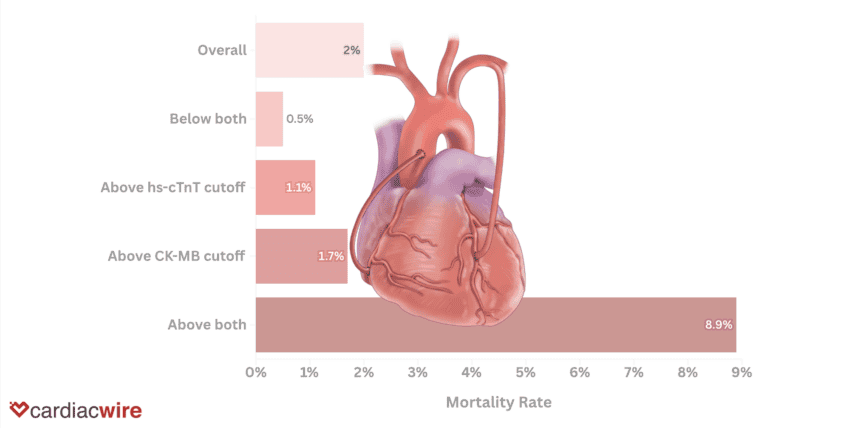
- The patient population’s all-cause mortality rate was 2%.
- When applying CK-MB and hs-cTnT separately, the biomarkers had similar (and solid) predictive accuracies (AUC 0.787 vs. 0.784) — though not quite at the clinical standard.
But together, the biomarkers delivered a bigger breakthrough. After researchers placed patients into three groups based on concentrations of each molecule, the pooled data showed…
- When both biomarkers were elevated beyond the diagnostic threshold, patients had mortality rates 18x higher than those with non-elevated concentrations (8.9% vs 0.5%).
- But elevated levels of CK-MB and hs-cTnT individually weren’t significantly associated with mortality.
Like the saying goes, two heads are better than one, and that’s true for cardiac biomarkers too. CK-MB and hs-CTnT measure cardiac injury differently, which might be part of this dual-marker approach’s success, while cluing us in to what future research needs to cover…
- For example, this study captured peak values of each biomarker, not continuous levels or when the peaks occurred.
- Since the molecules clear from the body on very different timelines (just 48-72 hours for CK-MB), time-specific data is needed to better define the risk categories.
The Takeaway
Accounting for high levels of both hs-CTnT and CK-MB instead of one or the other could help clinicians pinpoint who’s most at-risk of cardiac injury or death after CABG. This early detection could give cardiologists another chance to address patients’ complications before they become fatal.
|
|
Circadian Rhythms Revolutionize Cardiac Monitoring
Understanding a patient’s natural circadian rhythms can reveal deeper insights during cardiac monitoring. Find out how Monebo’s monitoring approach provides a visual representation of heart rate, cardiac muscle relaxation, and QT-RR throughout the circadian cycle.
|
|
The Benefits of Outsourced Post-Processing
Using an outsourced cardiac image post-processing solution doesn’t have to mean sacrificing control of the results. Discover how PIA’s customizable post-processing workflow can help you get the most out of your images.
|
|
- World’s Best Cardiology Care: U.S. cardiology care fared well in Newsweek’s 2027 global specialty ranking, with eight of the world’s ten best hospitals for CV conditions located stateside. Cleveland Clinic nabbed the top rank, while Mayo Clinic rose one spot from its place in U.S. News & World Report’s national rankings to take second. The Northeast region carried the success, with Mass General, Mount Sinai, NewYork Presbyterian, and Brigham and Women’s ranked at #3, #4, #8, and #10 worldwide.
- CVD Disparities Cross County Lines: CVD deaths are on the decline, but a new JACC study shows that progress isn’t being made equally. While age-standardized mortality rates declined 34% from 2000 to 2019, the authors noted significant variation in total burden and CVD drivers from county-to-county, far more than was seen between states. Racial disparities persisted even in counties with low mortality rates, leading Black Americans to face the largest CVD mortality burden of any racial or ethnic group at 305/100k people.
- Recommendations for Resistant Hypertension: In a new consensus statement, the ACC answered what it suspected were clinicians’ five most pressing questions about managing treatment-resistant hypertension. Topics ranged from ensuring consistent, simplified care across clinical settings using non-manual BP techniques to handling medication nonadherence with single-pill methods. Another section focused on a hot topic in cardiology: the incorporation of new technologies, namely wearable tech for at-home monitoring. While the ACC noted wearable devices aren’t ready to replace standard methods yet, experts did recommend remote surveillance whenever possible.
- BP Lowering for CKD: Speaking of BP management, a JAMA Cardiology meta-analysis showed intensive BP lowering appears to be safe and effective for patients with chronic kidney disease. Among 89k participants across 27 trials, each 10 mm Hg decrease in systolic BP corresponded with a 15% lower risk of CV events. Those cardioprotective effects persisted regardless of CKD status. While intensive BP treatment drove a 42% increased risk of ≥30% declines in kidney function as measured by eGFR, that didn’t translate into a higher risk of kidney failure.
- News for Nuevocor’s Cardiomyopathy Care: Biotech company Nuevocor had a big week. The company nabbed an FDA Fast Track designation and administered the first in-human dose in its Phase 1/2 SUNBEAM-LMNA trial. Both achievements surrounded NVC-001, an experimental gene-therapy treatment for adults with LMNA dilated cardiomyopathy, a high-risk condition which usually requires ICD implantation or heart transplant. The condition also lacks any approved disease-modifying treatments, which supports the FDA’s decision to expedite review for NVC-001.
- Surgical Menopause Raises Heart Risk: A meta-analysis of 36 studies and over 2.6M women found that iatrogenic (medically induced) menopause was associated with higher CV risk. The most common manifestations of CV risk included coronary heart disease (HR: 1.48), stroke (1.22), overall CV events (1.25), and all-cause mortality (1.08). The excess mortality was most common in women who underwent surgical menopause before age 45 and each 5-year increase in menopause onset past 45 was tied to progressively lower risk, so it may be more of a risk window rather than a cutoff.
- Canon Automates TAVR Workflow: Canon Medical Informatics launched Vitrea TAVR Assist+, a workflow automation application for its advanced visualization system that streamlines TAVR periprocedural planning. The tool automates key measurement steps, spanning the valve plane, annulus, coronary heights, and aortic root angle, which clinicians can review and edit, while also aiding delivery path and tortuosity assessments. This new Vitrea workflow arrives as TAVR demand grows following expanded CMS coverage for asymptomatic patients.
- Oxidized Lipids Starve Ischemic Hearts: New research suggests atherosclerotic lesions produce compounds that impair the blood vessel regrowth needed for ischemic heart recovery. Known as PGPC for short, researchers found that the compound was elevated and correlated with disease severity in CAD patients while also reducing collateral artery formation. PGPC suppressed new blood vessel formation by causing degradation of the STX17 protein in cell and mouse models. Restoring that protein pathway reversed the effect, suggesting PGPC or STX17 could be potential therapeutic targets to promote angiogenesis in CAD patients.
- Cleerly’s CV-CT Caravan: When communities lack access to CV care, they’re also often less likely to be included in clinical trials. Cleerly is looking to fill both gaps by bringing cardiac CT machines to areas lacking advanced imaging across Louisiana, Georgia, Arizona, and Florida. The effort supported Cleerly’s TRANSFORM trial to evaluate an AI-enabled CAD staging system. Since inaccessibility disproportionately affects rural and racial or ethnic minority communities, the initiative will likely provide trial data that’s more representative of the U.S. population as a whole.
- Lung Radiation and Pulmonary Hypertension: Radiation therapy for cancer already isn’t easy, and it could be tied to pulmonary hypertension. A study of 848 non-small cell lung cancer patients treated with thoracic radiotherapy found that PH development was common afterward with an incidence rate of 11.6% two years after therapy. Radiation dose to the pulmonary arteries best predicted the risk of developing PH, and patients who developed PH were more likely to have tricuspid disease and right ventricular systolic dysfunction.
- An Oral ASCVD Approach: Monte Rosa Therapeutics reported positive Phase 1 data for its oral ASCVD drug MRT-8102. The medication works by acting like a “molecular glue degrader” that targets the NLRP3/IL-1/IL-6 inflammatory pathway. Patients who took MRT-8102 for four weeks saw hsCRP decline by 85%, with 94% of patients reaching CRP below 2 mg/L (a threshold tied to lower CVD risk). Despite its immune suppressing effects, the medication didn’t increase infection risk. Monte Rosa plans to launch its Phase 2 study in H1 2027.
|
|
The EP-Heart Failure Collaborative Model
Cardiac contractility modulation therapy can significantly benefit heart failure patients who don’t receive CRT, with no extra training needed for EPs. Hear how Daniel A. Steinhaus, MD and Timothy J. Fendler, MD combined their HF and EP programs to better identify and serve the patients who need CCM.
|
|
Pulmonary Hypertension Detection With a Single Echo Clip
Pulmonary hypertension is often diagnosed late, when irreversible vascular remodelling has already occurred. That’s changing, however, with Us2.ai’s spatiotemporal transformer technology that can process apical four-chamber echo and accurately detects pulmonary hypertension far beyond the single-view echocardiographic benchmark.
|
|
VASCADE MVP® XL Vascular Closure System
Sometimes EP procedures call for a venous vascular closure system that is simply bigger. Haemonetics’ VASCADE MVP XL closure system comes with 58% more collagen and a 9% larger disc compared to the VASCADE MVP system as well as an expanded indication for utilizing 10-14F inner diameter sheaths.
|
|
- Earlier Detection, Better Outcomes: When it comes to heart disease, early detection is crucial to a patient’s long-term health. Learn more about how Fujifilm helps clinicians achieve that with the Lisendo 880 cardiovascular ultrasound system’s unique solutions that detect early abnormalities seen in heart failure, while offering insight into cardiac functions and groundbreaking hemodynamic analysis.
- Expand Your Cardiac Reporting with CCT and CMR Workflows: Cardiology imaging continues to grow in complexity, and reporting workflows must evolve to keep pace. Check out how Optum’s latest Change Healthcare Cardiology CPACS release enables cardiology teams to now report CCT and CMR studies natively within their software ecosystem.
- Canon’s 30 Years of Caring: For over 30 years, Canon has helped advance pediatric interventional cardiology through innovation and a commitment to better care. Learn more about how and why modern pediatric cardiac angiography came to be from one of its founding members, Dr. John P. Cheatham.
- Most Health Systems Have Deployed AI. Few Have Scaled It. 75% of health systems have deployed GenAI, yet only 4% report scaled implementation with measurable outcomes (Becker’s 2026). Cardiology shows the difference: HCM diagnosis in about three months versus 2 to 5 years, and pre discharge ILR placements up from 3 to 51. Join Viz.ai CMO Tim Showalter, MD on October 22 to hear what it takes. Register now.
- How to Operationalize and Scale a New CV Service Line: Advances in AI, imaging, and coronary CT are creating new opportunities for cardiovascular care. Explore this Frost & Sullivan Executive Brief for the key things to consider when establishing a coronary plaque service line—from choosing your delivery model to integrating AI cardiovascular imaging workflows and capturing reimbursement value.
- State-of-the-Art Cardiac Monitoring at Scale: Cleared for 13 different heart rhythm interpretations, AccurKardia’s AccurECG 2.0 shortens the time from an arrhythmia incident to clinical intervention. Watch here to find out how AccurKardia and Specialized Medical are teaming up to bring the AccurECG 2.0 technology to clinicians across the U.S.
- How AI Expands the Role of CMR Experts: If you’re an MRI technologist, AI could be the best thing that ever happened to your career. Read here to learn about the benefits of AI for CMR experts and how it can accelerate both your training and career.
- Integrating AI for Enhanced Echo: Sometimes it pays dividends to be an early adopter. Find out how the Christ Hospital’s early evaluation of Merge Cardio 12.5 allowed for remote echocardiography measurements, enhanced reporting accuracy, and a seamless user experience, bringing even greater efficiencies and clinical confidence.
|
|
|
|
|