|
BMI’s CVD Misses, An ASCVD Gene, and Curious Case Reports
By Viktor Zarev, Virginia Hunt
August 17, 2026
|
|
|

|
|
Together with
|

|
|
|
“In medicine, we are trained to master anatomy, physiology, and the latest guidelines — but no one teaches you that the right joke, at the right moment, can be powerful medicine.”
|
|
Michelle Kittleson, M.D.
|
|
|
Is it already that time of year again? That’s right, Cardiac Wire is back with another webinar on August 19th at 1:00pm ET. We’ll be hearing from two of the top voices in cardiac CT, Dr. Matthew Budoff and Dr. Jonathon Leipsic, about how they use the modality to diagnose and treat structural heart disease.
Hope you enjoy today’s issue,
Vik
|
|
|
|
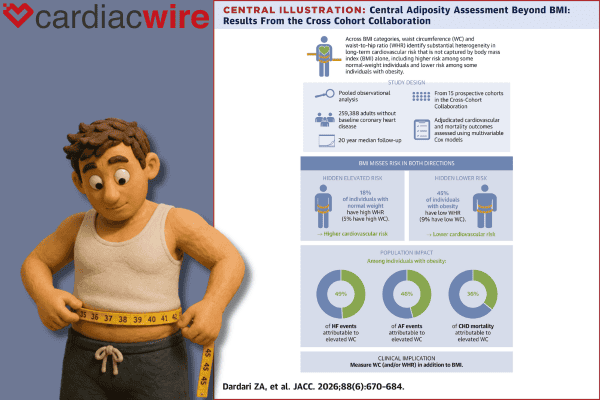
We all know BMI is pretty useless for predicting CV risk, and a new JACC analysis puts hard numbers on just how much it misses, including a high-risk group hiding in plain sight among “normal weight” patients.
- Body Mass Index (BMI) uses your height and weight to estimate your body fat, though it doesn’t distinguish between fat, muscle, and bone.
- Meanwhile, metrics like waist circumference (WC) and waist-to-hip ratio (WHR) have been used to quantify what’s called “central adiposity” or visceral fat.
If you’re up to date, you already know that visceral fat contributes directly to cardiovascular risk. This association prompted researchers to follow 260k patients with various WC and WHR measurements for a median of 20 years.
- Among people classified as normal by BMI, 5% had high WC and 18% had high WHR.
- Conversely, in those classified as obese by BMI, 9% had low WC and 45% had low WHR.
To right these BMI wrongs, researchers reclassified patients by WC and WHR to see those metrics’ prognostic value for nine CV outcomes ranging from HF to AFib, and all-cause mortality.
- For BMI normal-weight or overweight individuals, high WC or WHR was associated with 15% to 50% greater risk across most outcomes.
- Among people with BMI-defined obesity, low WC translated to lower all-cause mortality risk but no significant difference for other outcomes.
Does this mean we can make the case for measuring waists? Among people with obesity, elevated waist measurements coincided with a large share of events.
- Elevated WC was attributable to 49% of HF events, 46% of AFib events, and 36% of coronary heart disease mortality.
- That’s a substantial fraction of cardiovascular burden that BMI-based assessment alone would fail to flag.
There’s a timely treatment angle, too. The findings land as GLP-1s redefine how we manage weight loss, and more specifically, a patient’s organ fat.
- Novo Nordisk’s SELECT trial and studies on Eli Lilly’s Mounjaro found that GLP-1s lead to reduced CV risk likely tied to organ fat loss rather than total weight reduction.
The Takeaway
In Brazil, there’s this concept of a falsa magrinha (false skinny), where someone looks healthy, but it’s only because they mostly have weight from fat and not muscle. This JACC analysis gives us a way to catch the people who would slip through the BMI cracks and into CVD.
|
|
Fujifilm’s Ultrasound for every Cardiovascular Ultrasound Environment
From academia to clinical diagnostics, versatility in cardiac ultrasound is essential. Discover why clinicians are choosing Fujifilm’s LISENDO 880 for exceptional image quality, comprehensive strain analysis, stress imaging, and innovative Virtual Contrast technology — all while delivering outstanding value.
|
|
Expand Your Cardiac Reporting with CCT and CMR Workflows
Cardiology imaging continues to grow in complexity, and reporting workflows must evolve to keep pace. Check out how Optum’s latest Change Healthcare Cardiology CPACS release enables cardiology teams to now report CCT and CMR studies natively within their software ecosystem.
|
|
The Benefits of Outsourced Post-Processing
Using an outsourced cardiac image post-processing solution doesn’t have to mean sacrificing control of the results. Discover how PIA’s customizable post-processing workflow can help you get the most out of your images.
|
|
- The Gene Guarding the Coronary Arteries: Researchers probing LMOD1, a coronary artery disease risk gene of unknown function, found it protects against coronary atherosclerosis in mice. Because whole-body loss is lethal, they used a smooth-muscle-specific knockout that survived, and under atherogenic conditions those mice rapidly developed coronary atherosclerosis absent in controls. Further lineage tracing showed that 46% of plaque cells were smooth-muscle-derived. The authors conclude LMOD1 safeguards the coronary artery, independently of its usual smooth muscle role.
- Pediatric Cardiogenic Shock’s Roadmap: A new AHA scientific statement addresses pediatric heart failure–related cardiogenic shock, a high-mortality but understudied condition. The document offers a bedside diagnostic framework and proposes a pediatric-specific definition alongside the severity staging found in adult systems. Its authors also outline the initial approach to diagnosis and stabilization and provide guidance monitoring, noting that many children deteriorate within the first 24 hours.
- Vutrisiran’s Effect on Amyloid: One of the best ways to see how an ATTR-CM drug is working is to image the amyloid plaques throughout treatment. Researchers did just that in a post-hoc analysis of 43 HELIOS-B participants who underwent cardiac MRI, finding that Alnylam’s vutrisiran led to positive changes in cardiac structure, function, and amyloid burden. Treated patients showed improved biventricular ejection fractions and reduced left ventricular mass compared to placebo. Amyloid regression appeared in 22% of treated patients and no placebo patients.
- A Modified TAVR Trick for a Tricky Anatomy: Chinese specialists developed a modified TAVR technique which they dubbed noncoronary sinus pivot implantation (NCPI-plus) for a 74-year-old woman with severe aortic regurgitation and an enlarged left ventricular outflow tract. The approach creates a pivot along the annulus on the noncoronary sinus side with deep LVOT engagement for stable anchoring. The procedure succeeded with no paravalvular leak, and 12-month follow-up showed excellent valve function with less oversizing than the standard technique.
- Consider the Lungs in TAVR Planning: New findings in Heart & Lung suggest clinicians should heed incidental lung findings on preprocedural TAVR CT scans. Analyzing nearly 600 TAVR patients (mean age 80.6), researchers found interstitial lung abnormalities (ILAs) in 20.8% and emphysema in 23.7%. Notably, patients with an ILA faced significantly higher three-year mortality (57.6% vs. 36.4%) and impaired pulmonary function. The presence of ILA acted as an independent predictor of death, while incidental emphysema didn’t raise mortality risk.
- A Rare WATCHMAN Complication: A case report in JACC: Cardiovascular Interventions describes what the authors call the first known instance of late left atrial appendage occlusion device erosion requiring surgical excision. A 73-year-old woman on long-term prednisone presented two years after WATCHMAN FLX implantation with sudden chest pressure, hypotension, and hemopericardium. Surgery to remove the WATCHMAN revealed that a device anchor had eroded a hole in the pericardium, which the authors hypothesize occurred due to chronic corticosteroid use.
- Kardium’s Ablation System Cleared in Canada: Almost a year after Kardium’s Globe System for pulsed field ablation was cleared by the FDA, the medtech company is headed north. Health Canada recently approved the PFA system, which combines global mapping with precise ablation via its 122-electrode spherical catheter. The device’s all-in-one approach and ease of use are likely to perform well in Canada’s publicly funded, single-payer healthcare system which needs cost-effective and efficient procedural devices.
- Do the Work, Get the $15M: Atrium Therapeutics earned another $15M check from Bristol Myers Squibb, which means their research is going well. The milestone payment comes as a reward for the accurate delivery of a lead compound for the treatment of an unnamed cardiac indication. This gives Atrium a total of $30M out of the potential $1.35B in research milestone money that’s on the table from the company’s collaboration with BMS. The partnership is focused on developing new RNA-based therapies for multiple CV diseases.
- Aging’s Toll on Brain, Brawn, and Heart: The days of treating CVD as a siloed issue in older adults are over. The ACC’s new scientific statement recommends clinicians view frailty, cognitive impairment, and CVD as siblings borne from the same process: biological aging. The triad shares similar risk factors, from smoking to fitness level, so treating one often benefits the others. The authors advocate for a dual-approach to treatment that includes modified behaviors, like cognitive and physical training, plus pharmacological interventions, including anticoagulants and lipid-lowering therapies.
- Off-Sequence Heart Allocation: In one of the more peculiar trends we’ve seen, a UNOS analysis of 25.6k heart transplants from 2015 to 2024 found that out-of-sequence (OOS) allocation roughly doubled over the period (1.4% to 3.1%). OOS allocation occurs when a donated organ is offered, accepted, or transplanted into a candidate outside the current match waiting list. Curiously, OOS organs more often went to older, nonhospitalized women with type O blood and one-year survival was comparable to in-sequence recipients (93.1% vs. 91.6%).
- Orphan Drug Economics: A new Health Affairs analysis suggests orphan drugs don’t need protection from Medicare price negotiations, despite recent moves by Congress to expand this special treatment. The key finding: 94% of drugs with $200M+ in projected annual Medicare spending recovered clinical trial costs within a decade of launch, regardless of orphan status. There was no evidence that orphan drugs have an economic disadvantage, despite enjoying delays or exemptions from price talks. In fact, certain orphan drugs actually made back money faster than non-qualifying meds.
|
|
Redefining Cardiac Analytics
More data doesn’t equal deeper insight. There’s a fundamental difference between measuring the timing of heart beats and understanding how the heart recovers electrically after each beat. Monebo is using that distinction to define the next frontier of cardiac analytics.
|
|
Heart Failure Hospitalization Doubles Risk of Cardiovascular Death
21% of patients with symptomatic heart failure escalate to hospitalization for heart failure or cardiovascular death, and 25% of those who experience hospitalization are readmitted due to heart failure within one year of discharge. Watch Bayer’s Dr. Alanna Morris-Simon discuss heart failure hospitalizations and when to assess care plans.
|
|
CA Diagnosis Using Echo AI
Diagnosing cardiac amyloidosis using echo can be challenging due to the imaging overlap between CA and more prevalent causes of cardiomyopathy. Read more about how Us2.ai’s echocardiographic score and fully automated deep-learning model overcome this challenge to enable better diagnosis.
|
|
- How AI Expands the Role of CMR Experts: If you’re an MRI technologist, AI could be the best thing that ever happened to your career. Read here to learn about the benefits of AI for CMR experts and how it can accelerate both your training and career.
- Beyond the Calcium Score with Circle CVI: The coronary artery calcium score has been the non-invasive gold standard for a quick look at heart disease risk, but it only tells part of the story. Learn more about how Circle Cardiovascular Imaging is using AI-enabled coronary plaque analysis to redefine heart risk beyond what a CAC score can tell us.
- State-of-the-Art Cardiac Monitoring at Scale: Cleared for 13 different heart rhythm interpretations, AccurKardia’s AccurECG 2.0 shortens the time from an arrhythmia incident to clinical intervention. Watch here to find out how AccurKardia and Specialized Medical are teaming up to bring the AccurECG 2.0 technology to clinicians across the U.S.
- Merge Cardio 12.5 is Officially Available! From AI-generated echo measurements to upgraded UI and reports, Merge Cardio 12.5 brings a long list of new innovations to the table. Find out more about how Merge Cardio’s latest version streamlines workflows to make your cardiovascular service line more cost-effective and patient-centered.
|
|
|
|
|