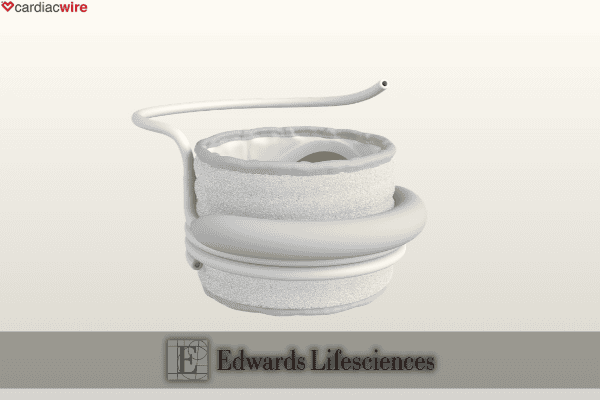
The left atrial appendage device space became far more competitive last week, following the launch of Medtronic’s Penditure LAA exclusion system and Johnson & Johnson MedTech’s acquisition of LAAX device company Laminar.
Medtronic made waves across the LAA closure segment, announcing the FDA approval and limited commercial launch of its Penditure LAA exclusion system.
- The Penditure system features a curved implantable clip that comes pre-loaded on a single-use delivery system
- It’s deployed during concomitant cardiac surgery procedures (vs. dedicated LAA interventions), and has the unique ability to be recaptured, repositioned, and redeployed
We usually have far earlier warning before Medtronic enters a completely new cardiac device segment, but that’s because it just acquired the Penditure system from medical device incubator Syntheon in August 2023.
Johnson & Johnson MedTech further expanded into the LAA space with its acquisition of left atrial appendage elimination (LAAX) device company Laminar for $400M, plus potential milestone payments.
- Laminar will become part of J&J’s Biosense Webster business, which already has a strong presence in EP ablation and intracardiac echo
- The Laminar LAAX device recently scored an FDA approval for its U.S. pivotal study, which will begin enrollment in early 2024
- Although not mentioned in the announcement, J&J also acquired Coherex Medical’s LAA system in 2015, which is reportedly still in development
If approved, J&J’s investigational Laminar LAAX device would hit the market long after the current LAA device players, although J&J seems to be optimistic about the Laminar system’s unique use of rotational motion to eliminate the LAA (vs. using plugs to occlude the LAA).
Medtronic and J&J would enter a competitive LAA closure segment that’s led by Boston Scientific, and also includes Abbott and AtriClip. It’s also likely large enough (estimated $1.4B to $2.2B) and growing fast enough (BSCI predicts 4x growth through 2030) to support more competitors.
- That said, AtriCure’s stock dipped 20% last week following Medtronic’s Penditure launch, in part because the two devices are both deployed during other cardiac procedures.
The Takeaway
Given that 38 million people worldwide are living with AFib, and roughly 40% of them can’t take blood thinners over long periods, there’s plenty of room for innovative new LAA devices.
Although the Penditure and Laminar systems are still largely unproven, the fact that they are both offered by medtech powerhouses and come equipped with unique new capabilities could make them well positioned among the next phase of LAA systems.