|
Cardiology’s Demographic Decline, Handheld ECG, and PH AI
By Viktor Zarev, Virginia Hunt
August 27, 2026
|
|
|

|
|
Together with
|

|
|
|
“The liberal use of the word ‘slop’ has gotten my attention this week. Medical student research is slop. Residency and fellowship research is slop. In fact, apparently most research that gets produced is slop… Most progress is not one spectacular paper appearing out of nowhere. It is built from a very large body of work, much of which may look pretty ordinary when viewed one project at a time.
“
|
|
Ann L. Jennerich, MD MS ATSF
|
|
|
It’s rare to get to hear from the Godfather of a whole imaging modality, so believe me when I tell you I was honored to speak with John P. Cheatham, MD about his contributions to Canon’s cutting edge pediatric angiography systems. You can watch the whole conversation here.
On the topic of cardiology Godfathers, today’s top story reveals an unsurprising trend. The speciality is getting older, with fewer young cardiologists to take up the mantle.
|
|
|
|
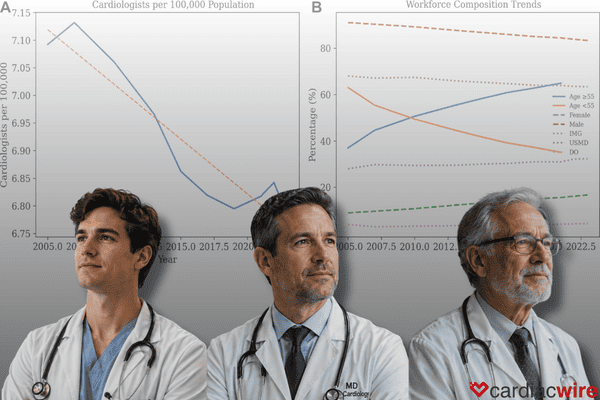
Here’s an encouraging factoid –the number of cardiologists in the U.S. rose in the last 20 years. However, a recent JACC study suggests per-capita cardiologist density has actually declined since 2003, and the average cardiologist’s age keeps creeping higher.
- The U.S. has long struggled to supply enough physicians for its aging population, mostly due to a combination of capped residency funding and baby-boomer demographics.
- That issue is even harder to address in a specialized branch of medicine like cardiology, despite CVD being the leading cause of death in America.
To better understand the shifting cardiology workforce, researchers analyzed AMA Physician Masterfile data reported from 2005-2023 with a keen eye for workforce size and composition relative to the U.S. population.
- Absolute cardiologist numbers rose modestly, from 21,117 in 2005 to 22,843 in 2023.
- But population growth outpaced that expansion, leading to a 0.29% annual decline in cardiologists per 100k people.
The more concerning trend is that the average cardiologist is getting older, meaning much of the workforce is set to retire in the next 10-15 years.
- The share of cardiologists aged 55+ jumped from 37.0% in 2005 to 64.9% by 2021.
- That aging trend will only get worse, since the young-to-old replacement ratio also fell significantly (-0.065 per year).
Cardiologist demographic composition also showed slight diversification, though the pace tells its own story.
- Female representation rose from 9.0% to 16.7%.
- But at the current rate, women wouldn’t reach 25% of the workforce until around 2040.
- International medical graduates also grew from 28.0% to 32.3% of the workforce.
It’s not like cardiologists grow on trees, so what do we do about the per-capita dip in the workforce?
- The study suggests reallocating cardiologists might be more pragmatic than simply training more.
- For example, late-career cardiologists could be used for consultative or call-free outpatient roles.
- And of course, advanced practice providers could help fill some care gaps, though probably not to the level seen in primary care.
The Takeaway
Despite raw numerical growth in the cardiologist workforce, we’re still barreling toward a shortage of professionals. This JACC study clarifies that it’s not for a lack of trying, rather a rapidly ageing patient and physician population.
|
|
Merge Cardio 12.5 is Officially Available!
From AI-generated echo measurements to upgraded UI and reports, Merge Cardio 12.5 brings a long list of new innovations to the table. Find out more about how Merge Cardio’s latest version streamlines workflows to make your cardiovascular service line more cost-effective and patient-centered.
|
|
How AI Expands the Role of CMR Experts
If you’re an MRI technologist, AI could be the best thing that ever happened to your career. Read here to learn about the benefits of AI for CMR experts and how it can accelerate both your training and opportunities.
|
|
- Study Questions CAC’s Predictive Power: CT-based CAC measurements are commonly used to predict future CVD, but a new JAMA study suggests there’s limits to CAC’s predictive power. Researchers added CAC scores to the existing PREVENT-ASCVD model of 10-year CVD risk, finding that among 6.1k people, CAC only “modestly improved” the model’s performance. CAC scores were also most useful for those at borderline or intermediate CVD risk, so they may not be needed in low-risk people.
- Handheld ECG Beats Holter: One of the most important things for treating arrhythmias is catching them early, and it seems like AliveCor’s handheld ECG can do just that. A prospective study in JACC: Advances found that AliveCor’s handheld KardiaMobile 6L (KM6L) ECG nearly doubled detection of clinically significant arrhythmias versus traditional ambulatory monitoring. Among 350 adults with unexplained palpitations or dizziness, the KM6L caught arrhythmias in 14.9% of patients versus 7.7% for standard monitors, with 11.1% of episodes captured only on the KM6L.
- Is TAVR Safe for Supersized Annuli? TAVR data may look more dangerous than SAVR for patients with large aortic annuli, but that’s partly because sicker patients receive TAVR. A JTCVS Open study of 414 patients revealed that 30-day mortality occurred in just 0.9% of TAVR patients and no SAVR patients. That said, one concerning trend emerged even after adjustment for baseline. Large annuli TAVR patients faced a 5x greater risk of developing HF risk compared to SAVR patients
- An ECG Flag for Pulmonary Hypertension: The FDA granted Tempus AI 510(k) clearance for its Tempus ECG-PH AI software device that analyzes standard 12-lead ECGs for pulmonary hypertension. The tool detects elevated mean pulmonary artery pressure in symptomatic patients aged 40+ without known PH, providing a binary output meant to complement, not replace, other diagnostics. It’s Tempus’ third FDA-cleared cardiovascular device and aims to help address a condition affecting roughly 1% of the population that’s often underdiagnosed because gold-standard diagnostics are invasive.
- Anticipating Anthracycline’s Effects: A new JACC CardioOncology study may have found a better way to predict the risk of cardiotoxicity for patients using anthracycline-based chemotherapies. Among 2.6k patients, the newly developed RE-ACT risk prediction system uses LVEF and the total anthracycline dose and showed higher accuracy at one year than the current HFA-ICOS system (83% vs. 76%). The real winner was a combination of the two, yielding 87% accuracy, due to a dual approach of HFA-ICOS for initial risk stratification and RE-ACT for prognostic prediction.
- Prioritizing Lesion Prep for DCB: Preventing target lesion failure is a challenge, but a Circulation: Cardiovascular Interventions study found a clue: optimizing lesion preparation. Among 406 patients treated with drug-coated balloons for in-stent restenosis, postpreparation percent diameter stenosis was the only modifiable risk factor. For every 10% increase in residual narrowing, a patient’s risk of TLF increased by 16%. The researchers note up-front decisions between DCBs and drug-eluting stents aren’t required, but the final choice might depend on how well lesion prep goes.
- Upstate NY Lawsuit Over CV Care: An acquisition jeopardized Ellis Medicine’s cardiovascular program, and now they’re suing to save their services. After St. Peter’s Health Partners acquired Cardiology Associates of Schenectady, the team of 27 cardiologists were supposed to be able to continue working with Ellis Medicine. Yet, a non-compete agreement forced them to cut ties. With acquisitions only expected to increase, the case inspired a NY state legislator to draft the Essential Health Care Access Protection Act to help govern contracts.
- Left-Behind Guidewires: The Texas Medical Board disciplined an interventional cardiologist for allegedly leaving a guidewire inside a patient during a 2022 pacemaker implantation. The issue surfaced in 2023 when the patient developed septic shock. Though a post-procedure CT showed the guidewire, the interventionist reportedly relied on the radiologist’s interpretation without viewing the imaging himself. He previously faced a $1.2M penalty over allegedly self-prescribing opioids and must now complete continuing education in pacemaker procedures and risk management.
- Sirolimus vs. Paclitaxel Balloons in PAD: New research suggests SCBs may offer a valuable alternative to PCBs, potentially sidestepping lingering questions about paclitaxel’s mortality risk. Researchers compared sirolimus-coated balloon angioplasty against the established paclitaxel-coated balloon in 482 patients with femoropopliteal artery disease. At 12 months, primary patency was comparable (73.9% vs. 74.9%) and the clinical endpoint was similar (90.5% vs. 92.7%), meeting noninferiority margins, though specific patency noninferiority was not statistically robust.
- QFR-Guided PCI Holds Up at 5 Years: Five-year data from the FAVOR III China trial confirms that quantitative flow ratio (QFR)-guided PCI improves long-term outcomes over angiography. Among patients with intermediate coronary lesions, MACE was lower with QFR guidance (17.5% vs. 21.1%), driven by fewer myocardial infarctions and ischemia-driven revascularizations, though all-cause death didn’t differ. That benefit accrued predominantly within the first two years, with similar outcomes between years 2 and 5.
- AI Reading Comes to Chest CT: Coreline Soft and INFINITT North America partnered to deploy a chest CT-based AI reading workflow at St. Joseph’s Health in New Jersey. The workflow embeds Coreline’s AVIEW platform directly into the hospital’s existing PACS, initially focusing on lung cancer screening exams where AI pre-analysis helps radiologists identify and quantify findings like lung nodules. The companies note chest CTs often contain actionable signs of lung cancer, emphysema, and cardiovascular risk, and plan to expand the integrated model regionally.
|
|
Circle CVI’s CAD-RADS Rundown
Ever wondered how CAD-RADS enhances the communication of coronary artery disease findings from imaging studies? Check out this guide from Circle Cardiovascular Imaging about the evolution of CAD-RADS and how to incorporate it into your practice.
|
|
Earlier Detection, Better Outcomes
When it comes to heart disease, early detection is crucial to a patient’s long-term health. Learn more about how Fujifilm helps clinicians achieve that with the Lisendo 880 cardiovascular ultrasound system’s unique solutions that detect early abnormalities seen in heart failure, while offering insight into cardiac functions and groundbreaking hemodynamic analysis.
|
|
Redefining Cardiac Analytics
More data doesn’t equal deeper insight. There’s a fundamental difference between measuring the timing of heart beats and understanding how the heart recovers electrically after each beat. Monebo is using that distinction to define the next frontier of cardiac analytics.
|
|
- Relieving The Burden of Post-Processing: With the advent of advanced imaging technologies like CCTA come added burdens to technologists and diagnostic imaging centers. See how PIA can relieve the burden of post-processing, saving you time while helping your bottom line.
- The Benefits of Cardiovascular Structured Reporting: Cardiovascular imaging’s growing demand means providers need structured reporting to manage their clinical workflows. Discover why Optum’s structured reports allow for more automated EHR and modality data while helping standardize clinical workflows.
- What Every Cardiologist Needs to Watch for in Heart Failure: Patients with preserved (HFpEF) or mildly reduced ejection fraction (HFmrEF) face a high risk of hospitalization for heart failure and cardiovascular death, even with guideline-directed medical treatment. Hear from Bayer’s Dr. Alanna Morris-Simon as she shares common heart failure signs to look out for.
- How Us2.ai Improves CA Screening: Cardiac amyloidosis may not be as rare as previously thought, with early and accurate detection becoming increasingly critical for treatment. Read about how the AI-SCREEN-CA study implemented Us2.ai’s automated CA reporting and AI-based pattern recognition analysis, leading to better disease screening at scale.
- State-of-the-Art Cardiac Monitoring at Scale: Cleared for 13 different heart rhythm interpretations, AccurKardia’s AccurECG 2.0 shortens the time from an arrhythmia incident to clinical intervention. Watch here to find out how AccurKardia and Specialized Medical are teaming up to bring the AccurECG 2.0 technology to clinicians across the U.S.
|
|
|
|
|